Expanded PTFE Joint Sealant Tape

100% expanded PTFE joint sealant — the dynamic seal for large, complex, damaged, or non-standard flanges. Just tear and paste. No tools, no cure time, no training needed.

✓ 100% ePTFE ✓ No Tools Needed ✓ -180°C to +260°C ✓ pH 0–14
Request a Quote

What Is ePTFE Joint Sealant Tape?

A conformable, dynamic seal that adapts to any flange geometry — including damaged and non-standard flanges.
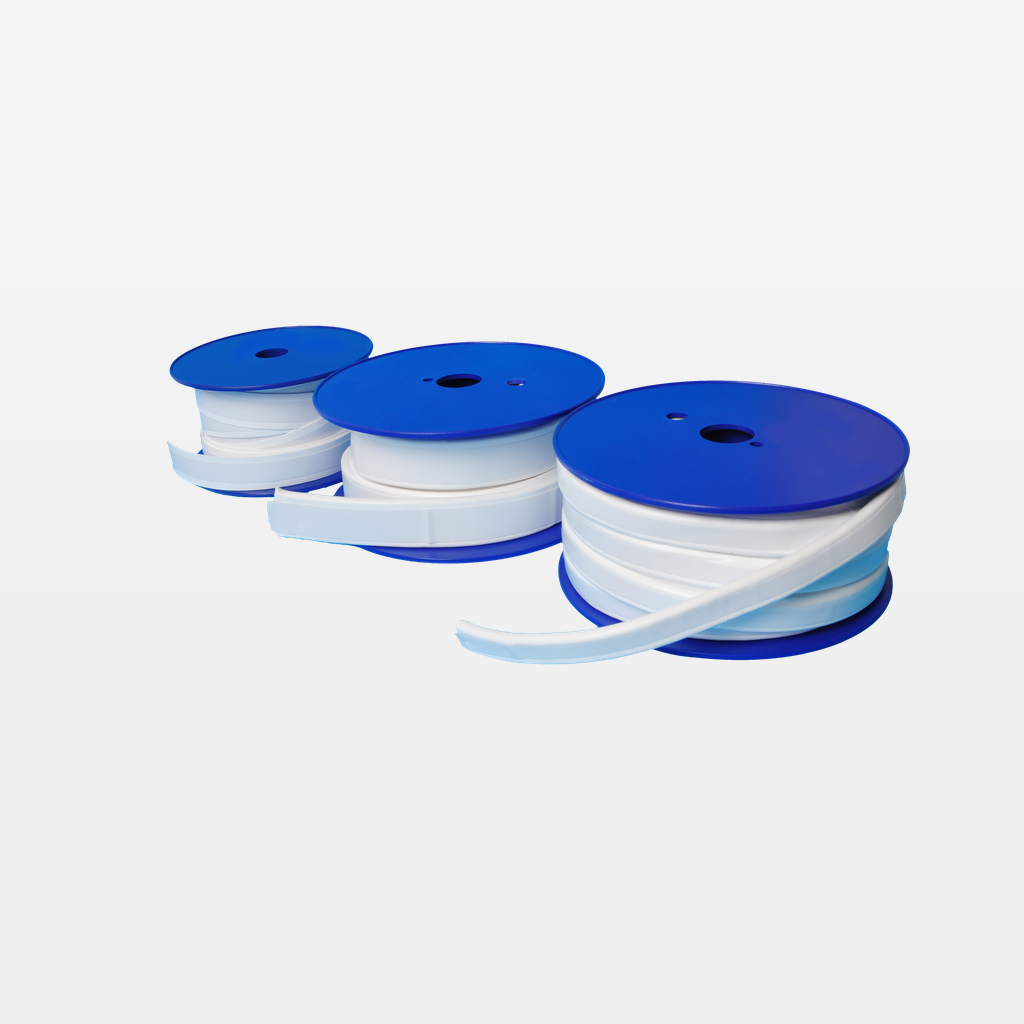
Expanded PTFE joint sealant tape on flange surface

ePTFE joint sealant tape is made from 100% expanded PTFE — no fillers, no binders, no adhesives. It is a soft, conformable, self-adhesive tape that seals flanges simply by being compressed between the mating surfaces.

Unlike pre-cut gaskets, ePTFE tape is a dynamic sealant: it conforms to the exact geometry of your flange at the moment of assembly, filling gaps, surface irregularities, voids, and minor damage that would defeat a rigid gasket.

Because there is no pre-formed shape, it works equally well on standard ANSI/ASME flanges, non-standard vessel openings, manways, handholes, and any irregular flange geometry. Just tear the tape to length, paste it on, and bolt up.

There is no minimum order quantity. Custom widths, thicknesses, and lengths are available.

Technical Specifications

100% expanded PTFE — no fillers, no binders. Every roll independently tested.

🌡️
-180°C ~ +260°C
Temperature Range
≥7 MPa
Tensile Strength (min)
↕️
≥120%
Elongation at Break
🧪
pH 0–14
Chemical Resistance
💧
Zero
Hydrolysis
🔄
100%
ePTFE — No Fillers
PropertyValueNotes
Temperature range-180°C to +260°CContinuous service temperature
Pressure ratingUp to flange pressure classSeal achieved at low bolt stress
Tensile strength≥7 MPa (minimum)ASTM D638
Elongation at break≥120% (minimum)ASTM D638
Chemical resistancepH 0–14All common industrial chemicals
Hydrolysis resistanceZero hydrolysisSafe for steam and water
Structure100% ePTFENo fillers, no binders

Available Sizes

8 standard dimensions. Custom widths, thicknesses, and lengths available on request.

Width (mm)Thickness (mm)Length (m)Typical Use
31.530Narrow flange gaps, small bore pipes
52.020Standard small flanges, DN15–DN50
72.515Medium flanges, DN50–DN100
103.08Large flanges, DN100–DN200
145.05Very large flanges, vessel manways
176.05Large vessel openings, heat exchangers
207.05Extra-large flanges, custom applications
2510.05Very wide gaps, heavily damaged flanges

Need a custom dimension? Contact us — we can produce to your exact specifications with no tooling cost.

How to Apply ePTFE Tape

No special tools, no curing time, no training needed. Three steps to a reliable seal.

1

Select & Cut

Choose the correct width for your flange bore. Tear the tape to length — no knife or scissors needed. Overlap the joint by 3–5mm to ensure continuous coverage around the circumference.

2

Apply to Flange

Peel and stick the tape onto the flange surface. Press firmly along the entire sealing surface to ensure good contact. The tape is self-adhesive and will stay in place during assembly.

3

Bolt & Pressurize

Assemble the joint and tighten bolts to recommended torque. The tape compresses to fill imperfections, voids, and surface irregularities. The seal is active immediately — no waiting, no cure cycle.

Seal Achieved — Instant, Reliable, Permanent

Works on damaged, warped, and uneven flanges. No re-torquing required. No cure cycle needed.

Why ePTFE Joint Sealant Tape?

Tape vs. gaskets — when to use ePTFE tape instead of a pre-cut gasket.

🧊 Seals Damaged & Complex Flanges

Unlike pre-cut gaskets, ePTFE tape is a dynamic sealant that adapts to the exact geometry of your flange at assembly. It fills gaps, pits, and surface damage that would cause a rigid gasket to leak.

🔧 No Special Tools Required

Just tear the tape and paste it on. No adhesive, no cure time, no specialized training. Works on-site, in the field, or in the workshop with equal ease.

⚡ Extremely Low Friction

ePTFE has one of the lowest coefficients of friction of any solid material. It is non-abrasive and protects flange faces from damage during assembly and disassembly.

💧 Zero Hydrolysis

Unlike many polymer sealing materials, ePTFE does not hydrolyze in the presence of water or steam. It remains flexible and maintains its seal integrity over time in wet or steam service.

🧪 Universal Chemical Resistance

100% ePTFE resists all common industrial chemicals across pH 0–14: acids, alkalis, solvents, oxidizers, and more. Only molten alkali metals and elemental fluorine affect it.

📐 Any Size, Any Shape

Because it comes as tape rather than a pre-cut shape, it can seal any flange geometry — round, oval, rectangular, irregular, manways, handholes, vessel openings — without custom tooling.

🔄 No Creep or Cold Flow

The expanded fibrillated structure provides high creep and cold-flow resistance. The seal remains stable under sustained load — no re-torquing needed after initial installation.

⏱️ Instant Seal — No Waiting

The seal is active the moment the bolts are tightened. No adhesive cure, no bake-out cycle, no waiting for the joint to "set". Process can be pressurized immediately.

Industry Applications

Used across industries wherever reliable, chemical-resistant flange sealing is required.

🧪 Chemical Processing

Handles aggressive chemicals across the full pH range. Used in chemical storage tanks, reactor vessels, heat exchangers, and piping systems where chemical compatibility is critical.

🍽️ Food & Beverage

FDA-compliant grades for food contact surfaces. Ideal for brewing, dairy processing, beverage production, and food-grade tank flanges where hygiene and chemical resistance are both required.

💊 Pharmaceutical

Clean, inert sealing for API manufacturing and sterile processing. USP Class VI compliance available on request for critical pharmaceutical process equipment.

⚙️ Pump & Valve

Reliable seals for pump casings, valve bonnets, and flange joints. Particularly effective on pump housings with irregular or worn faces.

💨 Steam Systems

Zero hydrolysis resistance makes ePTFE tape ideal for saturated steam and superheated steam applications. Does not harden or degrade in prolonged steam service.

🔧 Damaged Flanges & Emergency Repair

The most common use case for ePTFE tape: sealing flanges that are warped, pitted, corroded, or otherwise damaged. No need to resurface or replace the flange — tape fills the gaps.

🔩 Thread Sealing

Can be used as a thread sealant by wrapping on pipe threads before assembly. Replaces traditional PTFE thread tape with a more conformable, higher-pressure-rated alternative.

🏭 Non-Standard Flange Geometries

Manways, handholes, sight glasses, sampling ports, and any non-standard vessel opening. Because tape has no pre-formed shape, it adapts to any geometry.

Frequently Asked Questions

Common questions about ePTFE joint sealant tape from engineers and maintenance teams.

Q: How is ePTFE tape different from PTFE thread tape (plumber's tape)?
Standard PTFE thread tape is a thin, dense tape used for sealing pipe threads. ePTFE joint sealant tape is much thicker, wider, and more compressible — it is designed to seal flange faces, not pipe threads. It has much higher creep resistance than thread tape and can handle much higher pressures on large flange faces. ePTFE tape conforms to surface irregularities in a way that thin thread tape cannot.
Q: Can ePTFE tape be used on high-pressure flanges?
ePTFE tape seals at the bolt load applied — there is no fixed pressure rating independent of flange class. For high-pressure flanges (Class 300+, PN50+), simply ensure proper bolt torque is applied. The tape compresses and seals at the load provided. For extremely high pressures, consider using a greater number of tape passes or a thicker width.
Q: Does ePTFE tape work on painted or coated flanges?
For best results, apply ePTFE tape directly to clean bare metal flange faces. Paint or coating on the flange face can flake or chip under bolt load, creating voids beneath the tape. If the flange must be sealed with a coated face, ensure the coating is fully cured and firmly bonded before assembly.
Q: How do I choose the right tape width for my flange?
The tape width should be slightly wider than the flange sealing face (the raised face or the width between bolt holes for a flat face). As a general guide: use the tape width closest to your flange's nominal pipe size in mm. For very large flanges or vessel openings, choose a wider tape and apply multiple passes if needed.
Q: How much should I overlap the tape at the joint?
Overlap the tape by 3–5mm at the circumference joint. The overlap should be along the bore direction (not radially across the flange face) to avoid creating a raised step in the sealing surface.
Q: Can ePTFE tape be reused after disassembly?
No — ePTFE tape is a single-use product. Once compressed under bolt load, it conforms permanently to the flange surface. On disassembly, it should be replaced with fresh tape. This ensures the sealing surface is clean and the tape is at full thickness for the next assembly.
Q: Is ePTFE tape suitable for oxygen service?
Standard ePTFE tape contains no oils, greases, or organic additives that could react with oxygen. However, for oxygen service at high pressure or high temperature, specialized oxygen-compatible grades are recommended. Contact us to discuss your oxygen application requirements.
Q: What is the shelf life of ePTFE tape?
ePTFE tape has an indefinite shelf life. It does not age, harden, or degrade in storage. Rolls can be kept for years without loss of performance — making them ideal for maintenance spares inventory.

Sheet vs. Tape — Which to Choose?

Both are 100% ePTFE. The choice depends on your flange geometry and service conditions.

ScenarioRecommended ProductReason
Flat, full-face ANSI/ASME flangeePTFE Sheet (cut gasket)Clean, precise cut; easy installation
Damaged, warped, or worn flangeePTFE Joint Sealant TapeTape conforms to surface damage and fills voids
Very large flange / vessel openingePTFE Joint Sealant TapeNo large gasket needed; less material waste
Non-standard geometry (manways, handholes)ePTFE Joint Sealant TapeNo pre-formed shape needed
Repetitive same-size flanges (mass production)ePTFE Sheet (cut gasket)Consistent cut pieces; faster assembly
Thread sealing (pipe threads)ePTFE Thread Tape or Joint Sealant TapeTape wraps and seals pipe threads
Emergency field repairePTFE Joint Sealant TapeNo tools needed; immediate application

Need ePTFE Joint Sealant Tape?

Available in 8 standard sizes. Custom widths and lengths on request. No minimum order quantity. Global shipping.

Request a Quote