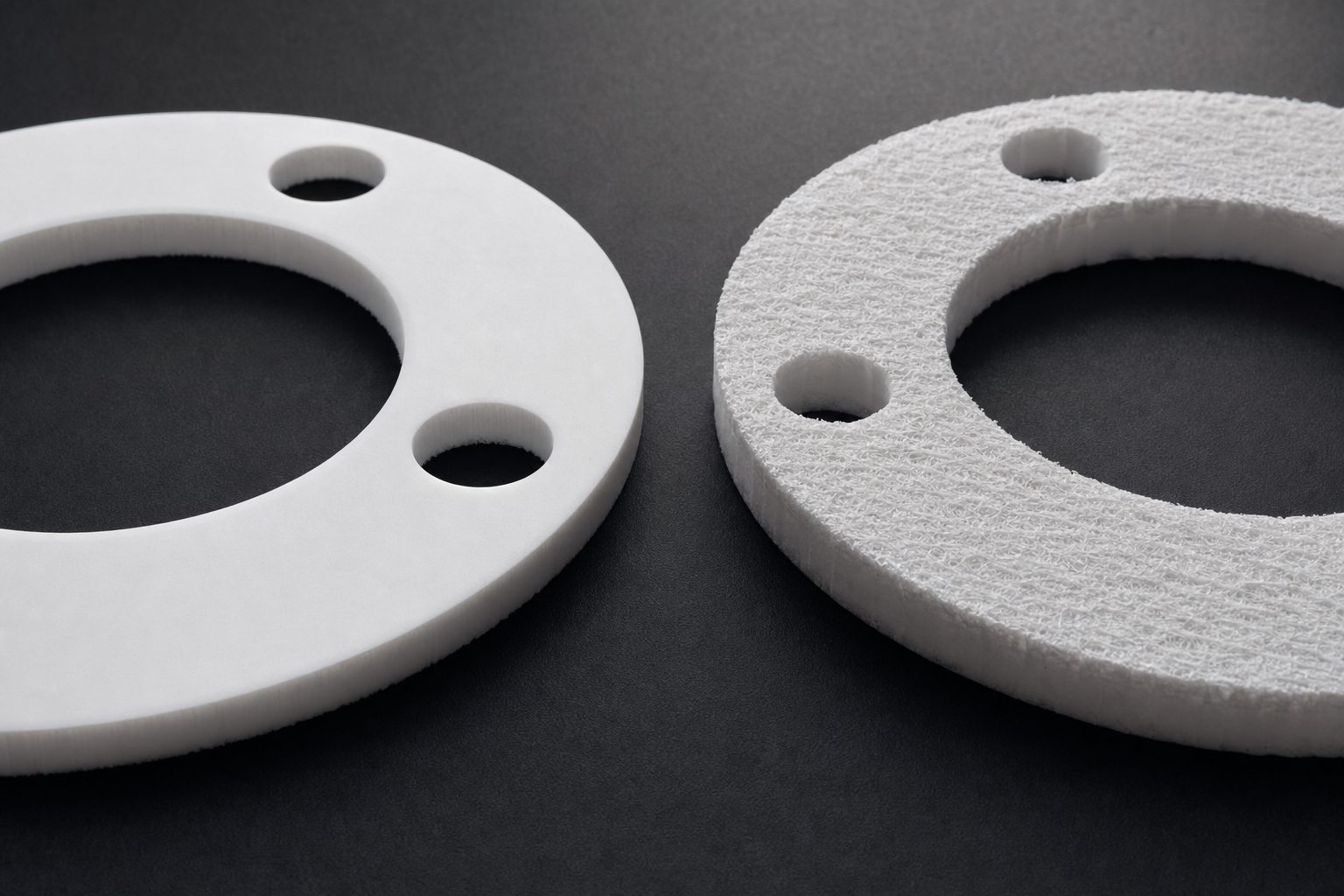
When selecting a sealing material for industrial applications, the choice between expanded PTFE (ePTFE) and standard PTFE is one of the most important decisions you'll make. Both materials share the same base chemistry — polytetrafluoroethylene — but their physical structures and performance characteristics are fundamentally different. Choosing the wrong material can mean frequent leaks, unplanned downtime, and costly maintenance.
This guide breaks down the key differences so you can make an informed decision for your flange system, pump, or valve sealing application.
What Standard PTFE Actually Is
Standard PTFE was discovered accidentally in 1938 by Roy Plunkett at DuPont. It's a fluoropolymer with one of the lowest coefficients of friction of any known solid material, making it excellent for bearing and slide surfaces. Its chemical inertness is legendary — virtually nothing attacks it except molten alkali metals and high-temperature fluorine.
But standard PTFE has a critical weakness: cold flow (also called creep). Under sustained mechanical load at elevated temperatures, PTFE molecules slowly reorganize and the material deforms permanently. A flange gasket that was 5mm thick when installed might compress to 4mm after six months, creating a gap that leads to leakage.
How ePTFE Is Different
Expanded PTFE solves the cold flow problem. The expansion process — patented by W.L. Gore in the 1970s — stretches PTFE at a controlled temperature below its melting point, creating a microporous fibrillated structure. At the microscopic level, ePTFE looks like a network of solid nodes connected by tiny fibrils — similar to a microscopic spring system.
These fibrils give ePTFE mechanical resilience that standard PTFE simply doesn't have. When you compress ePTFE, the fibrils resist and spring back. The material doesn't permanently deform under load. This single property change has enormous practical implications.
Head-to-Head Comparison
| Property | Standard PTFE | Expanded PTFE (ePTFE) |
|---|---|---|
| Cold Flow / Creep | Significant — deforms over time | Near zero — fibrillated structure resists deformation |
| Compressive Recovery | ~40-50% after load release | >95% — springs back reliably |
| Thermal Cycling Performance | Degrades — seal integrity worsens | Excellent — maintains seal through cycles |
| Seal Reliability | Good initially, degrades over time | Consistent long-term performance |
| Flange Conformability | Good — soft and pliable | Excellent — conforms to irregular surfaces |
| Chemical Resistance | Excellent (same base chemistry) | Excellent (same base chemistry) |
| Temperature Range | -200°C to +260°C | -260°C to +260°C (broader range) |
| Cost | Lower raw material cost | Higher — but lower total cost of ownership |
| Best For | Non-critical, low-pressure static seals | All demanding sealing applications |
The Cold Flow Problem in Practice
Consider a chemical processing plant with 200 flanges sealed with standard PTFE gaskets. At $50 per gasket and 2 hours of labor per re-tightening, each leak event costs approximately $450 in direct expenses alone. If standard PTFE gaskets fail every 18 months due to creep, that's $100,800 per year across the plant in maintenance costs — not counting production losses from unplanned shutdowns.
Replacing those with ePTFE gaskets at $120 each, with an expected service life of 5+ years, the same plant's annual sealing cost drops to roughly $9,600 — a 90% reduction in maintenance expense.
When Standard PTFE Is Still Acceptable
ePTFE isn't always necessary. Standard PTFE performs well in:
- Low-pressure water and air lines where leak consequences are minimal
- Static electrical insulation where mechanical load is negligible
- Liquid handling at ambient temperature and pressure
- Non-critical bearings and slides where periodic replacement is planned
But for any application where seal failure has real consequences — chemical leaks, safety hazards, production losses, or regulatory compliance requirements — ePTFE is the clear choice.
How to Identify ePTFE Quality
Not all ePTFE is equal. Quality indicators to look for:
- Brand reputation — Gore, Nichias, and established industrial manufacturers
- Compression recovery data — reputable suppliers publish this
- Material traceability — quality certificates (EN 10204 3.1) with batch numbers
- Consistent thickness — premium ePTFE has uniform gauge across the entire sheet
Be wary of very low-priced ePTFE from unknown sources — compression properties can vary widely and substandard ePTFE may exhibit creep closer to standard PTFE.
Conclusion
The ePTFE vs PTFE decision ultimately comes down to your application requirements. If your sealing application involves any of the following, ePTFE is worth the investment:
- Elevated temperature or thermal cycling
- Sustained bolt load over time
- Chemical exposure at temperature
- Pressure fluctuations or vibration
- Irregular or damaged flange surfaces
- Any situation where unplanned downtime is costly
For standard PTFE, the lower upfront cost is tempting, but the total cost of ownership — in maintenance, leaks, and unplanned shutdowns — almost always makes ePTFE the more economical choice for serious industrial applications.
← Back to Articles