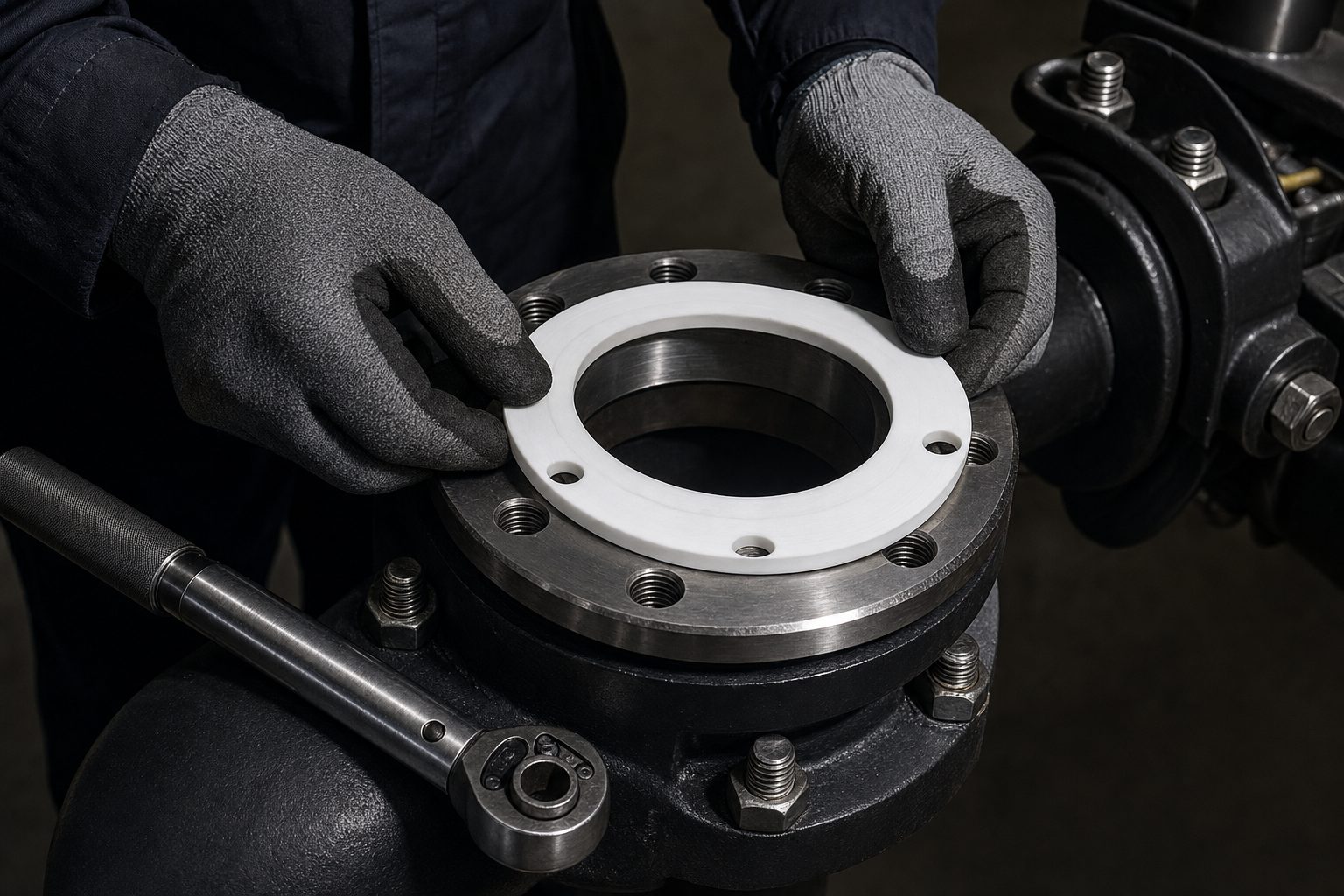
Even the highest-quality expanded PTFE gasket will fail if installed incorrectly. The good news: ePTFE is one of the most forgiving sealing materials to install. Its softness and conformability compensate for many common installation errors that would immediately destroy a conventional gasket.
This guide walks through the proper installation procedure for ePTFE gaskets — from flange inspection to final torque verification.
Before You Begin: Gather Your Tools
Proper ePTFE gasket installation requires:
- Torque wrench — calibrated, appropriate range for your bolt size
- Torque sequence chart for your flange type
- Flange cleaning tools — scraper, solvent, clean rags
- Gauge or caliper — to verify gasket thickness
- Personal protective equipment — gloves, safety glasses
- Anti-seize compound (optional) — for high-temperature applications
Step 1: Inspect and Clean the Flanges
Why This Matters
One of ePTFE's advantages is its ability to conform to damaged flange surfaces. But before relying on this, you should still ensure flanges are reasonably clean. Old gasket residue, rust, scale, and debris can create stress points that compromise the seal.
Remove the old gasket completely. Use a gasket scraper (never a wire brush on spiral-wound gaskets near the sealing surface) to remove all residual material. Clean the gasket seating surfaces with a suitable solvent — acetone or a dedicated flange cleaner work well. Wipe dry with a clean, lint-free cloth.
Inspect the flange face for:
- Warping — visible distortion of the seating surface
- Pitting and corrosion — small pits can create leak paths
- Gouges and scratches — deeper than 0.5mm may need attention
- Flange face flatness — use a straightedge to check for gaps
For lightly damaged flanges, ePTFE will conform and seal. For severely damaged surfaces, consider resurfacing or replacing the flange.
Step 2: Inspect the ePTFE Gasket
Before installation, check the gasket:
- Verify dimensions match your specification (ID, OD, thickness)
- Check for any visible damage — tears, delamination, contamination
- Store gaskets in their original packaging until ready to install
- Do not apply adhesive or sealant to ePTFE — it isn't necessary
Step 3: Position the Gasket
Center the ePTFE gasket precisely on the flange bore. Do not extend the gasket OD beyond the bolt circle — this makes alignment and subsequent removal much easier. For pipe flanges, ensure the gasket is centered on the pipe bore, not offset.
ePTFE gaskets are not directional — either face can seal. Do not worry about which side faces the media.
Step 4: Assemble the Flange and Hand-Tighten
Carefully lower the mating flange onto the gasket. Insert all bolts by hand — never start threads with a wrench. Hand-tighten bolts in a star pattern to roughly 20-30% of final torque. This holds everything in place before final torque.
Step 5: Apply Final Torque in Stages
Torque in at least three stages using a calibrated torque wrench. Always follow the star pattern:
- Stage 1: 30% of target torque — snugs all bolts evenly
- Stage 2: 60% of target torque — begins gasket compression
- Stage 3: 100% of target torque — final seal compression
The star pattern means torquing opposite bolts first, then moving to the next pair — never adjacent bolts. For a standard 8-bolt flange: tighten bolts 1 and 5 first, then 3 and 7, then 2 and 6, then 4 and 8.
Target torque depends on your gasket dimensions and flange rating. Typical values for ePTFE gaskets:
- PN16 / Class 150: 40-60 Nm for M12 bolts
- PN40 / Class 300: 80-120 Nm for M16 bolts
- PN63-100 / Class 600: 150-250 Nm for M20-M24 bolts
Always use manufacturer-recommended torque values for your specific flange. Over-torquing can extrude and damage the gasket. Under-torquing creates an inadequate seal.
Step 6: Re-torque After Initial Heat-Up (Critical Step)
ePTFE Is Different Here
Unlike spiral-wound gaskets, ePTFE gaskets do not need re-torquing after the system is brought to operating temperature. ePTFE's fibrillated structure maintains its bolt load retention without relaxation. Skip this step — it's unnecessary for ePTFE and can actually disturb a well-seated gasket.
Special Considerations by Application
Steam Service
Steam flanges experience significant thermal expansion. For steam applications, use ePTFE gaskets rated to 260°C and ensure proper support during startup. Allow the system to warm up gradually — rapid temperature spikes can cause uneven expansion.
Cryogenic Service
ePTFE remains flexible at cryogenic temperatures (-260°C). For LNG and liquid gas applications, ensure the gasket is fully compressed before cooling — thermal contraction of the flange will reduce bolt load. Consider 10-15% higher initial torque for cryogenic service.
Glass-Lined Flanges
Glass-lined flanges have very fragile surfaces. ePTFE is ideal here — its softness prevents damage to the glass coating. Use lower torque values (50-70% of standard) and always use a protective felt or rubber pad between the bolt head and flange surface.
Oxygen Service
For oxygen applications, cleanliness is absolutely critical. Any hydrocarbon contamination (oils, grease, fingerprints) can cause violent combustion in high-pressure oxygen. Use oxygen-compatible ePTFE and handle with clean, oil-free gloves throughout installation.
Common Installation Mistakes to Avoid
- Reusing old gaskets — always replace with a new ePTFE gasket every time the flange is opened
- Over-torquing — ePTFE extrudes under excessive pressure; follow torque specs
- Wrong gasket size — gasket ID must match the pipe bore, OD should not extend beyond bolt circle
- Contaminating the gasket surface — keep ePTFE clean from oils, grease, and debris
- Skipping the star pattern — uneven bolt loading causes gasket misalignment and leaks
- Not verifying torque — use a calibrated torque wrench, never impact wrench
How Long Does an ePTFE Gasket Last?
Properly installed ePTFE gaskets typically provide 5-15+ years of reliable service. Unlike conventional gaskets, ePTFE doesn't harden, crack, or cold-flow over time. The gasket only needs replacement when the flange is opened for maintenance.
Signs that indicate a gasket replacement is needed:
- Visible leakage at the flange joint
- Flange is being opened for other maintenance
- Gasket shows signs of chemical attack or deterioration
Need Custom Gaskets?
We supply custom-cut ePTFE gaskets to your exact dimensions. Contact our engineering team with your flange specifications — we can supply cut-to-size gaskets with tolerances up to ±0.5mm.
← Back to Articles