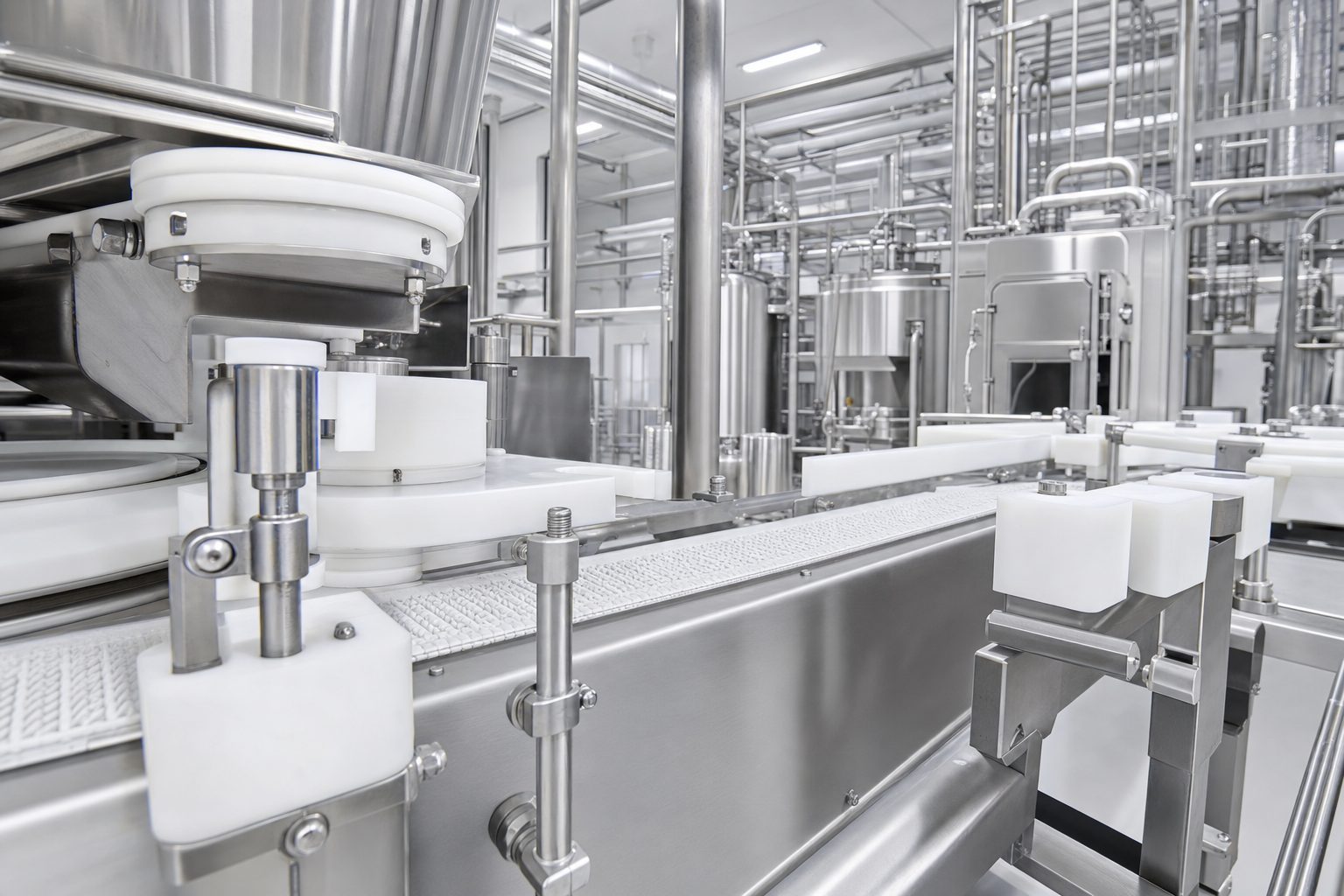
PTFE has become indispensable in food processing and pharmaceutical manufacturing. Its unique combination of chemical inertness, non-stick surface, wide temperature range, and mechanical resilience makes it ideal for everything from baking ovens to sterile drug manufacturing. But using the right grade matters — regulatory compliance is not optional in these industries.
This guide covers the regulatory landscape, material grades, and selection criteria for PTFE components in food and pharmaceutical applications.
Why PTFE Is Used in Food & Pharma
PTFE's value proposition for food and pharmaceutical applications is straightforward:
- Non-reactive — no chemical migration into food or pharmaceutical products
- Non-stick surface — prevents product buildup, reduces cleaning time
- Temperature range — -200°C to +260°C handles pasteurization, sterilization, and cryogenic storage
- FDA compliant grades available — meets regulatory requirements out of the box
- Can be sterilized — survives autoclave, gamma radiation, and chemical sterilization
- Low friction — reduces product damage in handling and conveyance
Understanding Regulatory Standards
FDA Compliance (United States)
21 CFR 177 — Indirect Food Additives
FDA regulation 21 CFR 177.1550 covers fluoropolymers including PTFE. It specifies that PTFE components must be made from virgin material (no reprocessed or recycled PTFE) and must not contain any substances restricted under FDA regulations. Components made from FDA-compliant PTFE are considered safe for repeated food contact.
For food processing equipment, the relevant FDA regulations include:
- 21 CFR 177.1550 — Fluoropolymers (PTFE, FEP, PFA)
- 21 CFR 177.1380 — Fluorocarbon elastomers
- 21 CFR 110 — Good Manufacturing Practice (GMP) requirements
USP Class VI (United States Pharmacopeia)
USP Class VI Biological Testing
USP Class VI is a testing standard for materials used in medical devices and pharmaceutical processing. It involves three tests: Acute Systemic Toxicity, Intracutaneous Toxicity, and Implantation Tests. Materials that pass USP Class VI testing are certified safe for contact with biological systems and pharmaceutical products.
USP Class VI certification is essential for:
- Pharmaceutical manufacturing equipment seals
- Bioreactor components
- Drug delivery system components
- Sterile processing equipment
- Medical device manufacturing tooling
EU Food Contact Regulations
For the European market, PTFE materials must comply with:
- EU Regulation 1935/2004 — Framework regulation for food contact materials
- EU Regulation 10/2011 — Specific measures for plastic materials in contact with food
- German BfR Recommendations — Bundesinstitut für Risikobewertung guidelines
EU regulations often require specific migration testing — even if a material is FDA-approved, it may need additional testing for EU market compliance.
3-A Sanitary Standards
In the United States, 3-A Sanitary Standards define design criteria for dairy and food processing equipment. While PTFE itself isn't specifically covered, PTFE components used in 3-A certified equipment must meet the same material safety requirements — FDA compliance is the baseline.
Material Grades Explained
| Grade | Regulatory Status | Best For |
|---|---|---|
| Virgin PTFE | 21 CFR 177.1550 compliant | General food contact — baking, conveyance, storage |
| Virgin PTFE + USP Class VI | FDA + USP Class VI | Pharmaceutical processing, biopharma, sterile applications |
| Expanded PTFE (ePTFE) | FDA compliant grades available | High-purity seals, sterile processing, food-grade gaskets |
| FEP / PFA | 21 CFR 177.1550 compliant | Transparent food processing, liquid handling |
| UHMWPE | FDA compliant | Impact-resistant food contact surfaces, cutting boards |
Critical Considerations
Virgin vs. Reprocessed PTFE
FDA compliance requires virgin PTFE only. Reprocessed or recycled PTFE may contain contaminants from previous use, process residues, or foreign materials introduced during regrinding. Always specify virgin PTFE for food and pharmaceutical applications and request material certificates confirming virgin status.
Fillers and Additives
Filled PTFE compounds — glass-filled, carbon-filled, graphite-filled — are generally not FDA compliant for food contact unless specifically tested and certified. The filler materials themselves may not meet food safety standards, and the filler-matrix interface can create migration risks. Use only virgin or specifically certified filled compounds.
Colorants
Any pigment or colorant added to PTFE must also be FDA-approved for food contact. Natural/unpigmented PTFE is preferred for food and pharmaceutical applications. If color-coding is required for process identification, use only FDA-approved colorants and confirm with your supplier.
Temperature and Pressure Ratings
FDA compliance and USP Class VI certification cover material safety — they do not guarantee mechanical performance. Ensure your PTFE component is rated for your actual operating temperature and pressure. ePTFE gaskets typically maintain seal integrity at -260°C to +260°C, but mechanical loads and flange conditions matter.
Common Food & Pharma Applications
Food Processing
- Baking and confectionery — PTFE conveyor belts, non-stick sheets for baking trays
- Dairy processing — ePTFE gaskets for HTST pasteurizers, UHT sterilizers
- Beverage processing — valve seats, pump seals, tank gaskets
- Meat and poultry — wear strips, guide rails, conveyor components
- Fruit and vegetable processing — seals for juice extractors, pasteurizers
Pharmaceutical Manufacturing
- Sterile filtration — PTFE membrane support structures
- Bioreactors — seals, gaskets, stirrer components
- Lyophilization (freeze-drying) — chamber seals, door gaskets
- Tablet press tooling — punches and dies with PTFE coatings
- Aseptic filling — sterile valve seals, tank gaskets, piping gaskets
- API synthesis — corrosion-resistant seals for aggressive chemical processes
Cleaning and Sterilization
PTFE is compatible with most cleaning and sterilization methods used in food and pharmaceutical processing:
| Method | Compatibility | Notes |
|---|---|---|
| Steam Sterilization (Autoclave) | Excellent | Up to 135°C, multiple cycles |
| Gamma Radiation | Excellent | Up to 50 kGy typical |
| Ethylene Oxide (EtO) | Excellent | Standard sterilization gas |
| Chemical Sanitizers (CIP) | Excellent | Acids, alkalis, sanitizers |
| Ultrasonic Cleaning | Excellent | No special precautions |
| VHP (Vaporized H2O2) | Excellent | Standard for aseptic processing |
How to Specify Food/Pharma Grade PTFE
When requesting quotes or placing orders, be explicit about your compliance requirements:
- State the standard required (FDA 21 CFR, USP Class VI, EU Regulation)
- Request material certificates and batch traceability
- Specify the application (temperature, pressure, media, cleaning method)
- Ask for extractables data if available for critical pharma applications
- Confirm the material is virgin (not reprocessed or recycled)
Need Food or Pharma Grade PTFE?
We supply FDA-compliant and USP Class VI certified PTFE materials for food processing and pharmaceutical manufacturing. Contact our engineering team with your compliance requirements and application details.
← Back to Articles