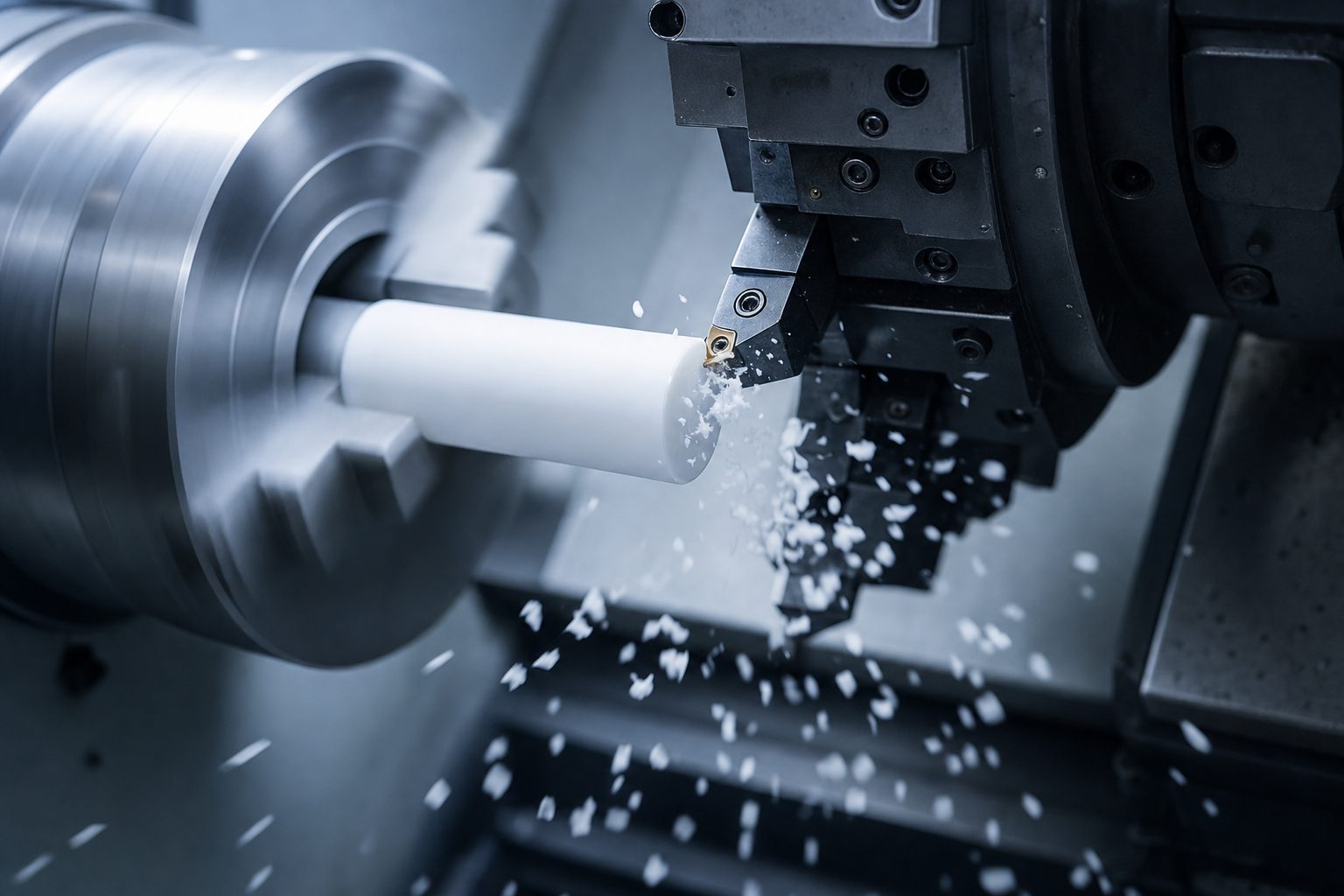
CNC machining is the most versatile method for producing custom PTFE parts. Unlike injection molding (which requires expensive tooling) or compression molding (limited to simple shapes), CNC machining can produce complex geometries, tight tolerances, and small-batch runs without any tooling cost.
Whether you need a single prototype part or 10,000 production pieces, CNC machining delivers precision PTFE components for pumps, valves, seals, insulators, and hundreds of other industrial applications.
Why Machine PTFE?
PTFE is one of the most machinable of all engineering plastics. Key advantages:
- No special tooling required — standard HSS and carbide cutting tools work well
- No curing or cooling needed — PTFE machines dry, no coolant contamination issues
- Excellent chip formation — long, continuous chips that clear easily from the work area
- Very low cutting forces — thin-walled parts and complex profiles are achievable
- No fire hazard — unlike some plastics that melt and stick to tooling
Our CNC Machining Capabilities
Tolerances
Standard: ±0.05mm. Precision: ±0.01mm on critical dimensions. Surface finish up to Ra 0.8μm.
Materials
Virgin PTFE, Glass/Carbon/Graphite-filled PTFE, PEEK, UHMWPE, Nylon, Delrin/POM, PCTFE, PVDF, and more.
Order Volume
No minimum order quantity. Single prototypes welcome. Large production runs with consistent quality.
Lead Time
Standard: 5-15 business days. Rush service available (2-3 day turnaround for urgent requirements).
File Formats
PDF, DWG, DXF, STEP, STP, IGES, SLDPRT (SolidWorks), X_T (ParaSOLID). Hand-drawn sketches accepted.
Quality Documentation
Material certificates (EN 10204 3.1), dimensional inspection reports, and certificates of conformance available.
PTFE Machining: Key Considerations
Tooling
PTFE machines with standard HSS tools for general work. For production runs and better surface finish, carbide tooling is preferred. Diamond-coated tools are used for very long production runs to minimize tool wear.
Key tool geometry for PTFE:
- Large rake angles (15-25°) — reduces cutting forces and improves chip flow
- Sharp cutting edge — PTFE dulls tools quickly; resharpen frequently
- Large chip gullets — accommodates PTFE's long, stringy chips
Cutting Speeds and Feeds
| Operation | Cutting Speed (m/min) | Feed Rate |
|---|---|---|
| Turning (rough) | 60-120 | 0.2-0.4 mm/rev |
| Turning (finish) | 150-200 | 0.05-0.15 mm/rev |
| Milling (rough) | 80-150 | 0.1-0.3 mm/tooth |
| Milling (finish) | 150-250 | 0.03-0.1 mm/tooth |
| Drilling | 40-80 | 0.1-0.3 mm/rev |
Cooling
PTFE machines well dry (no coolant) because it's self-lubricating and won't stick to the tool. However, for critical surface finish and tight tolerances, a light flood of water-soluble coolant helps control heat. Never use oil-based coolant — PTFE absorbs oil, degrading its properties.
Dimensional Stability
PTFE has a high coefficient of thermal expansion (120 x 10⁻⁶/°C) — approximately 10x that of steel. This means machined parts can change dimension significantly between the machine shop temperature and the operating environment. Key strategies:
- Machine critical dimensions last to minimize time between cutting and measurement
- Allow parts to equilibrate to room temperature before final measurement
- Account for thermal expansion in your design tolerance stack-up
Typical PTFE Machined Parts
Common applications for CNC machined PTFE parts:
- Pump components — impellers, bearings, shaft sleeves, piston rings, valve seats
- Sealing components — custom gaskets, V-rings, u-cups, flange seals, custom seal profiles
- Electrical insulators — standoff insulators, terminal blocks, high-frequency components
- Slide bearings — linear bearing rails, wear pads, guide bushings
- Medical components — FDA-grade custom shapes for pharmaceutical and medical devices
- Semiconductor handling — wafer carriers, process chamber components
- Chemical process parts — dip tubes, weir plates, spray nozzles, custom vessel internals
Filled PTFE Compounds
Virgin PTFE is very soft and wears quickly under abrasive conditions. For demanding applications, filled PTFE compounds offer improved mechanical properties:
| Fill Material | Property Improved | Application |
|---|---|---|
| Glass (15-25%) | Compressive strength, wear resistance | Static seals, pump parts |
| Carbon (25%) | Wear resistance, thermal conductivity | Dynamic seals, bearings |
| Graphite (15%) | Dry running, thermal conductivity | Dynamic seals, slide bearings |
| Carbon Fiber (25%) | High strength, dimensional stability | Structural parts, aerospace |
| Bronze (40-60%) | Wear resistance, thermal conductivity | Heavy-duty bearings |
How to Order Custom PTFE Parts
Ordering is straightforward:
- Submit your drawing — PDF, CAD, or sketch via email
- Specify material — virgin PTFE or specific filled compound
- State quantity and deadline — even for single parts
- We'll review and quote — typically within 2 hours during business hours
- Approve and pay — we start production immediately
- Quality inspection — dimensional report provided with shipment
Get a Custom Quote
Send your drawings to sales@liantuoptfe.com. We respond within 2 hours.
Request Quote